AI LEADERSHIP PROGRAM

Navigate the AI Shift

AI is changing how organizations work, and twelve to eighteen months into the shift, many are discovering that the hardest gap is not technical. It is organizational.

Navigate the AI Shift is a research-backed AI leadership program built around five challenges senior leaders are experiencing, with practical tools to help them and their teams to increase their impact as the organization adapts.

95%

of enterprise generative-AI pilots show no measurable P&L impact, despite $30-40 billion in investment.

93%

of senior AI and data leaders identify human factors as the primary barrier to AI adoption.

60%

of companies see little or no material value from AI; only 5% achieve sustained impact at scale.

OUR EXECUTIVE RESEARCH

What Senior Leaders Told us is Getting Harder

In April 2026, we interviewed 13 senior executives across tech, finance, and consulting to understand how the AI shift is changing the work of leadership in practice. Rather than asking what AI can do, we focused on what leaders are carrying now: where strategy, judgment, people, and execution are becoming harder to hold together.

Five challenges surfaced repeatedly. We then asked all 13 executives to rate them; the percentages show how many rated each challenge as significant.

Executive Blind Spots in 2026
The five challenges 13 senior executives named as the hardest part of leading through AI, ranked
01 Running strategy and execution at once
92% 12 of 13

Direction and delivery collapse into one motion. The plan can expire mid-quarter.

02 Leading beyond expertise
69% 9 of 13

Value shifts from having the answer to framing the question and judging the output.

03 Integrating technology and social change
62% 8 of 13

AI arrives as technology but is lived as a threat to role and status. Adoption stalls in the gap.

04 Carrying the weight of velocity
54% 7 of 13

More consequential calls, faster, on less information, with the same demand for certainty.

05 Maintaining culture and belonging
54% 7 of 13

Connection stops happening by default and has to be designed on purpose.

AI LEADERSHIP ASSESSMENT

Where is the Pressure Showing Up Most in Your Organization?

 Assess your organization against the five challenges from the research and identify where focused leadership attention could create the greatest impact.

WORK THE CHALLENGES WITH PEERS WHO GET IT

A Program Built Around Your Day-to-Day Work

Based on our executive research, we built an AI Leadership Playbook around the five AI challenges leaders are navigating now. This is not a lecture series. We apply the playbook to live leadership problems, using the cohort to compare approaches, challenge assumptions, and think out loud with peers carrying similar complexity. 

It fits around a full executive schedule: focused group sessions and practical work applied directly to your day-to-day leadership. Not more work on your calendar. A better way to work with what is already on it.

Running Strategy and Execution at Once

The Shift: Stay focused on where you’re going while adapting quickly when something genuinely changes.

Leading Beyond Expertise

The Shift: Stay credible and valuable without needing to have all the answers.

Integrating Technology and Social Change

The Shift: Help people adapt to AI by clarifying what’s changing, what it means, and how to move forward.

Carrying the Weight of Velocity

The Shift: Make high-stakes decisions with less certainty, without carrying every decision yourself.

Maintaining Culture and Belonging

The Shift: Keep the trust, mentoring, and connection that can quietly disappear as work gets more automated.

What You Leave With: 

• A practical operating system for AI-driven change
• 15 tested tools, ready to use
• A clear view of where to adapt next

A short application, followed by a 60-minute conversation to see if the cohort is the right fit.

THE RESEARCH

The research behind the white paper

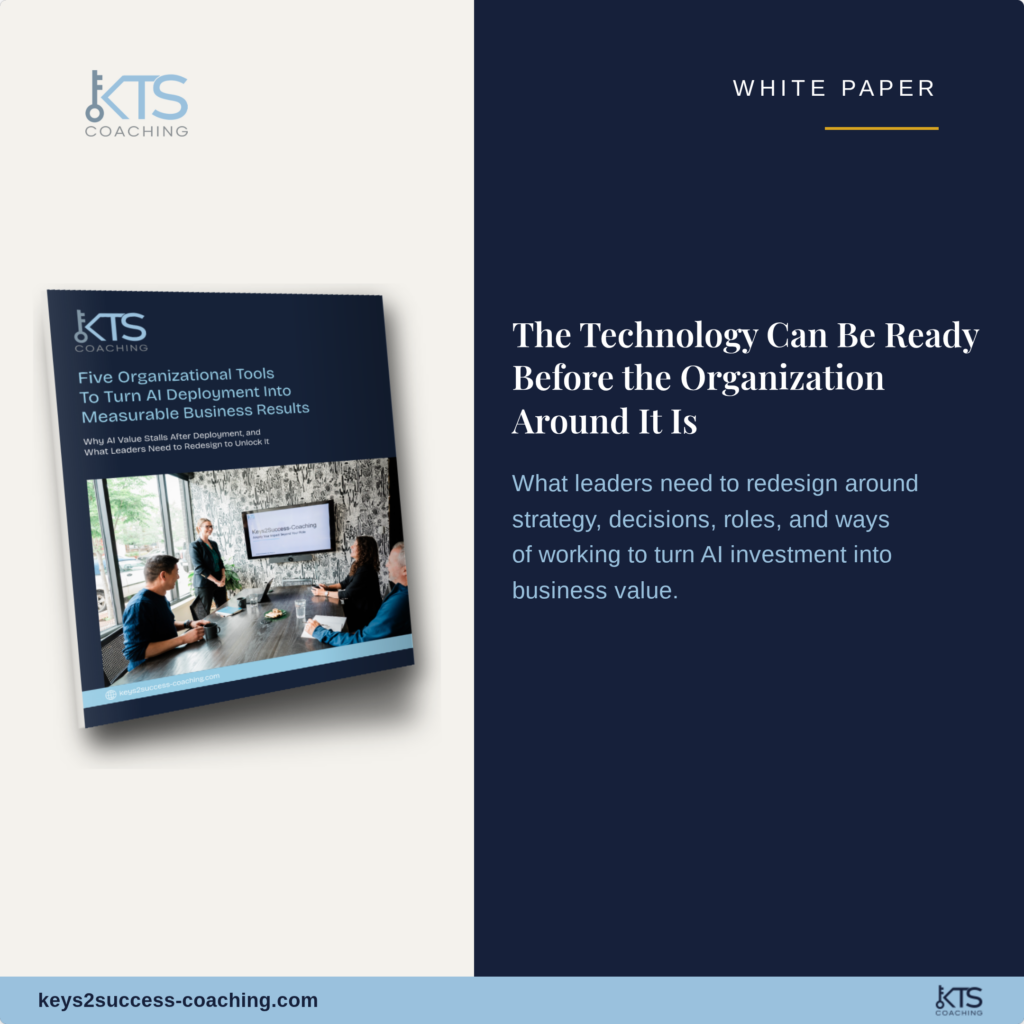
In April 2026 we interviewed 13 senior executives on leading through the AI shift. 92% named running strategy and execution at once as their number one challenge. The white paper distills what they carry, and five organizational tools you can run with your leadership team this quarter.